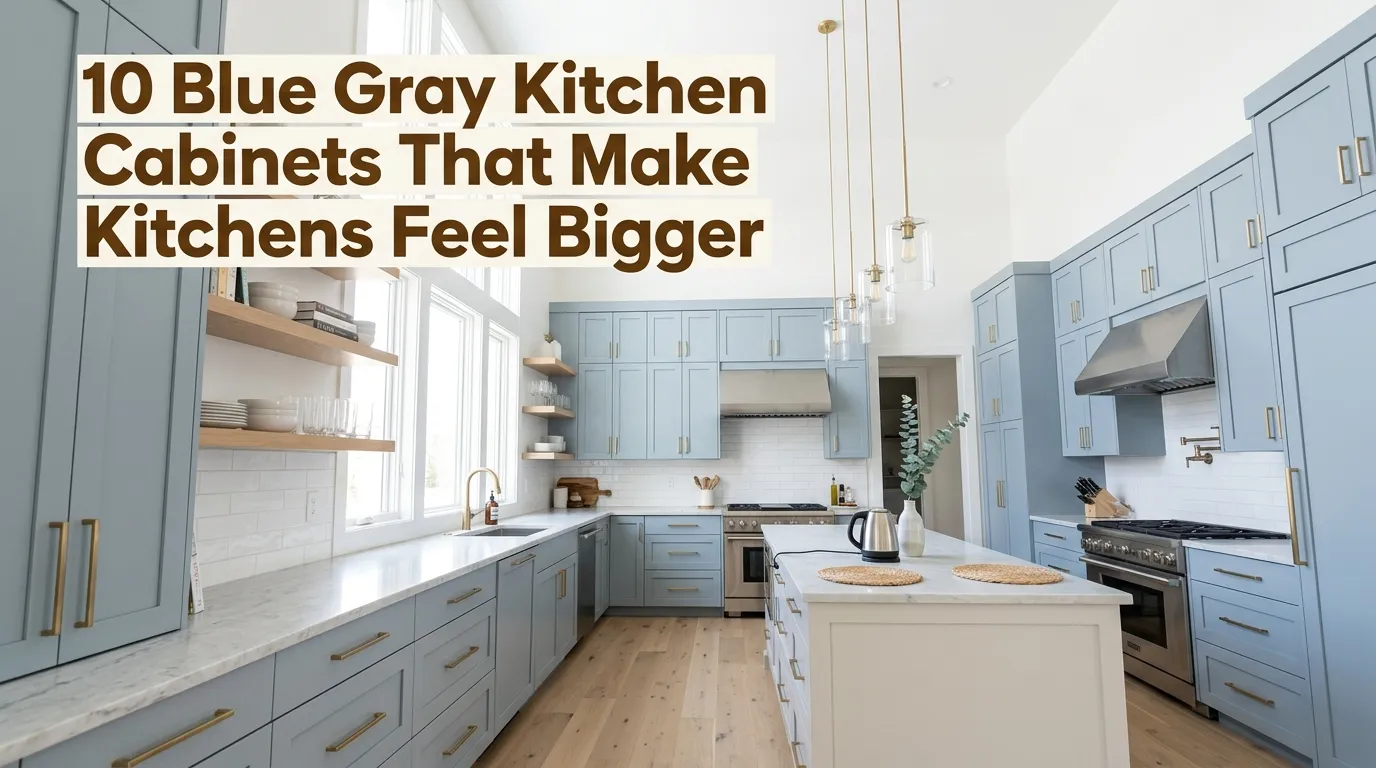
10 Blue Gray Kitchen Cabinets That Make Kitchens Feel Bigger
A kitchen can feel cramped even when it has a reasonable amount of square footage. Dark finishes, bulky cabinetry, limited natural light, and too many contrasting colors can make the room feel visually crowded.
That is one reason blue gray kitchen cabinets have become such a versatile choice for homeowners who want color without making the kitchen feel heavy.
Blue gray sits between cool blue and neutral gray, giving cabinetry a softer appearance than many saturated colors. Depending on the shade, lighting, countertop, and surrounding finishes, it can feel coastal, traditional, modern, transitional, or quietly sophisticated.
But the color itself isn’t what makes a kitchen feel larger.
The real difference comes from how you use it.
Cabinet color needs to work with the room’s natural light, countertop, backsplash, flooring, hardware, and overall layout. A pale blue gray paired with white counters can visually open up a small kitchen, while a deeper blue gray may work better as an island color or lower-cabinet finish.
I’ve noticed that the most successful kitchens using this palette don’t rely on one shade everywhere. Instead, they create contrast carefully. White walls, reflective surfaces, open shelving, glass-front cabinets, warm wood, and simple hardware can all prevent blue gray cabinetry from overwhelming the room.
You also don’t need to remodel the entire kitchen to bring in this look. Painting existing cabinets, replacing hardware, updating the backsplash, or changing the lighting can create a meaningful transformation.
Whether you’re planning a full kitchen renovation or simply collecting ideas for a future project, these blue gray cabinet combinations show how to use this versatile color while keeping the room bright, balanced, and visually spacious.
Table of Contents
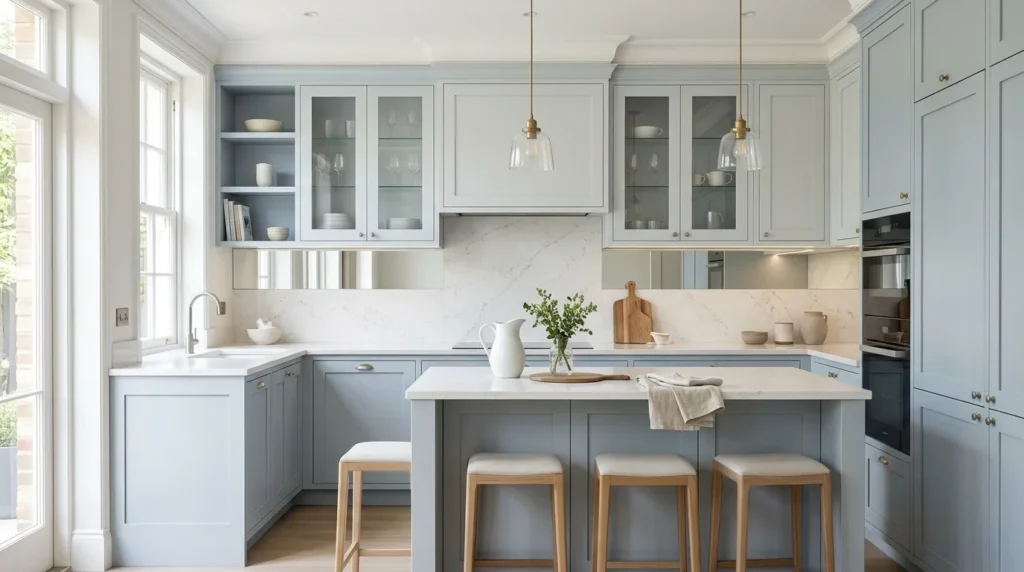
1. Pale Blue Gray
Use a soft cabinet color with light surfaces to create an airy and open kitchen.
2. White Marble Contrast
Pair blue gray cabinetry with a bright marble-look counter for a timeless combination.
3. Blue Gray Island
Use the color selectively on the island while keeping perimeter cabinets lighter.
4. Light Wood Accents
Combine blue gray cabinets with natural wood for warmth and visual balance.
5. Glass Cabinet Doors
Use glass-front storage to break up solid cabinetry and increase visual openness.
6. White Subway Tile
Pair blue gray cabinets with a classic backsplash for a clean, bright backdrop.
7. Brass Hardware
Add warm metallic accents to soften cool blue gray cabinetry.
8. Open Shelving
Replace or supplement some upper cabinetry with open shelves to create breathing room.
9. Two-Tone Cabinetry
Combine blue gray with white or cream cabinetry to create contrast without heaviness.
10. Soft Blue Gray
Use a muted, slightly warm blue gray to create a calm and spacious appearance.
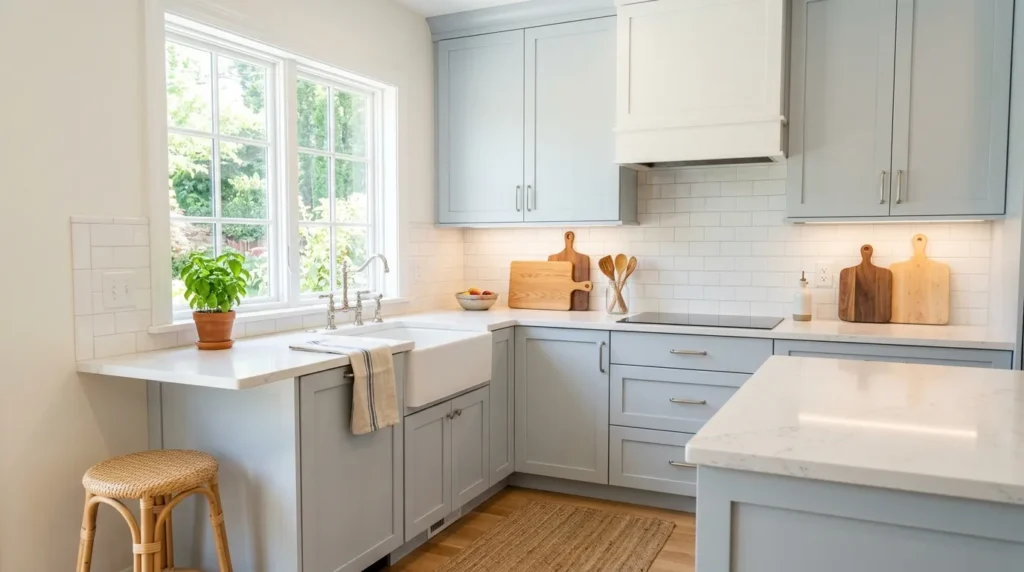
1. Pale Blue Gray
Quick Benefits
- Keeps cabinetry visually light
- Works well with white surfaces
- Reflects natural light softly
- Creates a calm atmosphere
- Fits small and large kitchens
Why It Works
When a kitchen feels tight, very dark cabinetry can make the walls appear closer together.
A pale blue gray provides color without the visual weight of navy, charcoal, or deep forest green.
The result is especially effective when paired with light countertops and backsplash materials.
The cabinetry still has enough color to give the room personality, but it doesn’t dominate the space.
This shade also works beautifully with natural daylight.
As the light changes throughout the day, pale blue gray can shift subtly between blue, gray, and neutral tones, giving the kitchen dimension without requiring additional decorative elements.
How To Style It
Pair pale blue gray cabinets with:
- White quartz
- Light marble
- Warm white walls
- Pale oak flooring
- Brushed nickel hardware
For a slightly warmer look, add natural wood cutting boards, woven counter stools, or light oak accessories.
Keep countertops relatively uncluttered.
In a small kitchen, visual simplicity can be just as important as the cabinet color.
Use under-cabinet lighting to brighten work surfaces and make the cabinetry feel more dimensional in the evening.
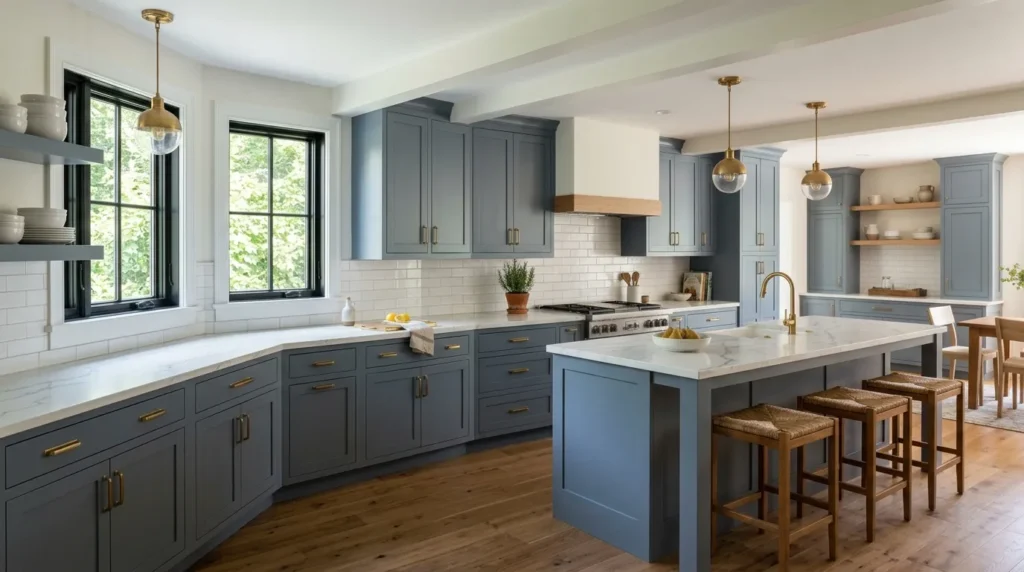
2. White Marble Contrast
Quick Benefits
- Creates strong light-dark balance
- Looks timeless
- Adds visual brightness
- Works with traditional and modern kitchens
- Highlights cabinet color
Why It Works
Blue gray cabinetry and white marble create a classic contrast.
The darker cabinet color provides definition, while the bright countertop reflects light and keeps the lower portion of the kitchen from feeling too heavy.
Marble’s natural veining also introduces movement.
If you prefer a lower-maintenance material, a marble-look quartz can provide a similar visual effect.
The important part is keeping the countertop relatively bright and visually connected to the backsplash.
How To Style It
Choose a white or soft-white counter with subtle gray veining.
Repeat the gray tones in the backsplash or flooring.
Use simple cabinet hardware so the countertop remains one of the visual highlights.
White walls can further increase the sense of openness.
For warmth, add natural wood stools or a small wooden cutting board.
Avoid introducing too many competing colors.
The combination works best when the palette stays focused on blue gray, white, gray, and natural wood.
3. Blue Gray Island
Quick Benefits
- Adds color without covering every cabinet
- Creates a focal point
- Keeps perimeter cabinetry bright
- Works well in open kitchens
- Offers flexibility during remodeling
Why It Works
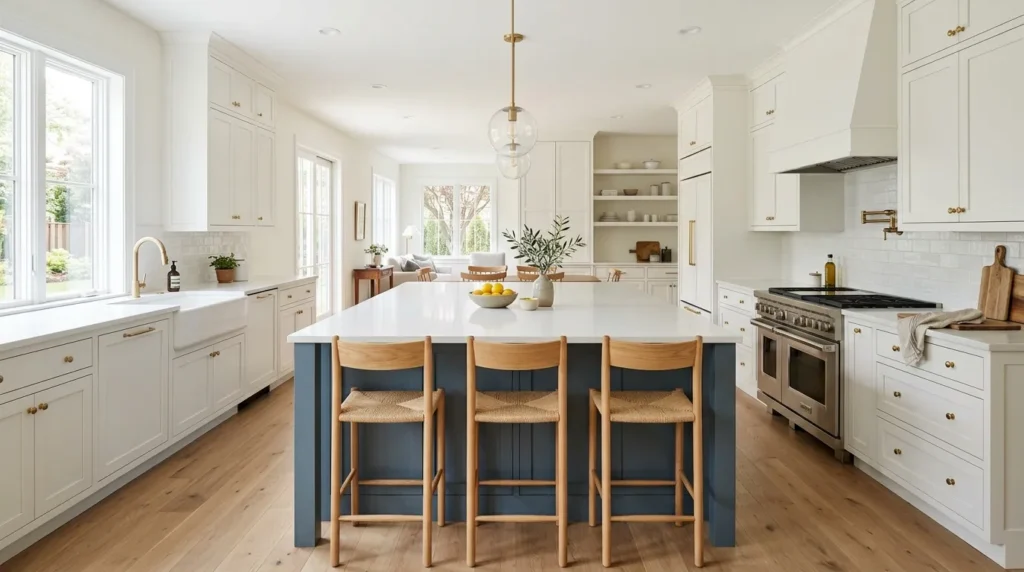
You don’t have to paint every cabinet blue gray.
Using the shade only on the kitchen island can give you the character of colored cabinetry while keeping the main perimeter visually light.
This approach is particularly useful in kitchens with white perimeter cabinets.
The island becomes a central focal point while the lighter cabinets visually blend into the walls.
It can also be an easier update if you’re not ready to commit to changing the entire kitchen.
How To Style It
Use blue gray on the island and white or warm cream on the perimeter cabinets.
Repeat the island color subtly elsewhere.
A blue gray runner, barstool cushion, vase, or artwork can connect the palette without making the room feel overly coordinated.
Choose a light countertop for the island if the space is small.
For hardware, brushed brass, matte black, or brushed nickel can work depending on the surrounding finishes.
Keep the rest of the kitchen relatively restrained.
4. Light Wood Accents
Quick Benefits
- Adds warmth
- Balances cool tones
- Creates natural contrast
- Works with modern and traditional styles
- Prevents a sterile appearance
Why It Works
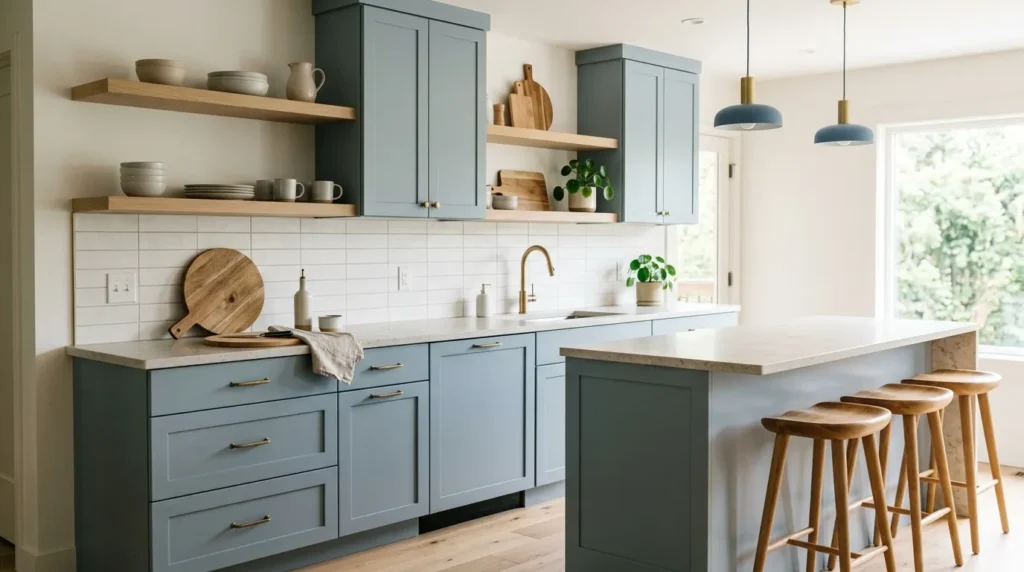
Blue gray can sometimes feel cool when paired exclusively with white and gray.
Natural wood solves that problem.
The warmth of oak, maple, walnut, or other appropriate wood tones provides contrast while maintaining a relaxed appearance.
This combination can make a kitchen feel more welcoming without adding bright colors.
Wood also adds texture.
That texture becomes particularly valuable in kitchens with smooth painted cabinets and stone countertops.
How To Style It
Try blue gray cabinets with:
- Light oak flooring
- Wood bar stools
- Open oak shelving
- A wood island
- Natural cutting boards
- Woven accessories
For a brighter kitchen, choose pale oak.
For a more dramatic look, medium or walnut-toned wood can create richer contrast.
Avoid using too many different wood tones.
One or two coordinated finishes are usually enough.
5. Glass Cabinet Doors
Quick Benefits
- Breaks up solid cabinetry
- Creates visual depth
- Displays attractive dishes
- Adds lightness
- Works well in compact kitchens
Why It Works
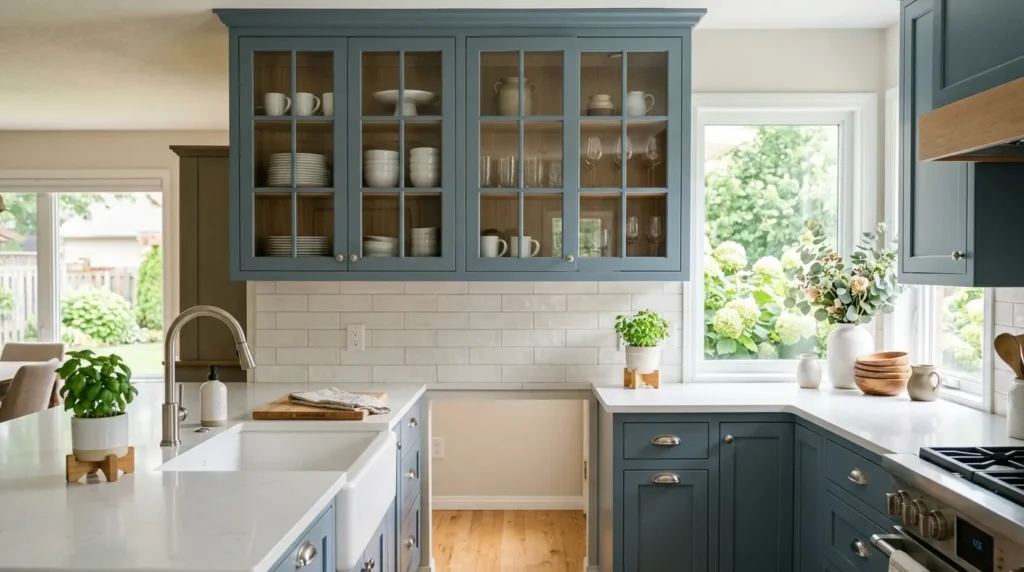
A long wall of solid cabinets can feel visually dense.
Glass-front doors introduce transparency.
You can still have enclosed storage while giving the eye a glimpse beyond the cabinet fronts.
This can make the upper section of the kitchen feel less imposing.
Glass also reflects and distributes light differently than a solid painted surface.
It’s particularly effective when used selectively rather than on every cabinet.
How To Style It
Choose one or two upper cabinets for glass fronts.
Display a small collection of attractive dishes, glasses, bowls, or serving pieces.
Keep the contents organized.
Overfilled glass cabinets can create the exact opposite effect.
Clear glass offers a traditional appearance, while lightly textured or reeded glass provides additional visual interest while partially concealing contents.
Use simple hardware that complements the rest of the kitchen.
6. White Subway Tile
Quick Benefits
- Brightens the backsplash
- Creates a clean backdrop
- Complements blue gray
- Works across decorating styles
- Can make the wall feel continuous
Why It Works
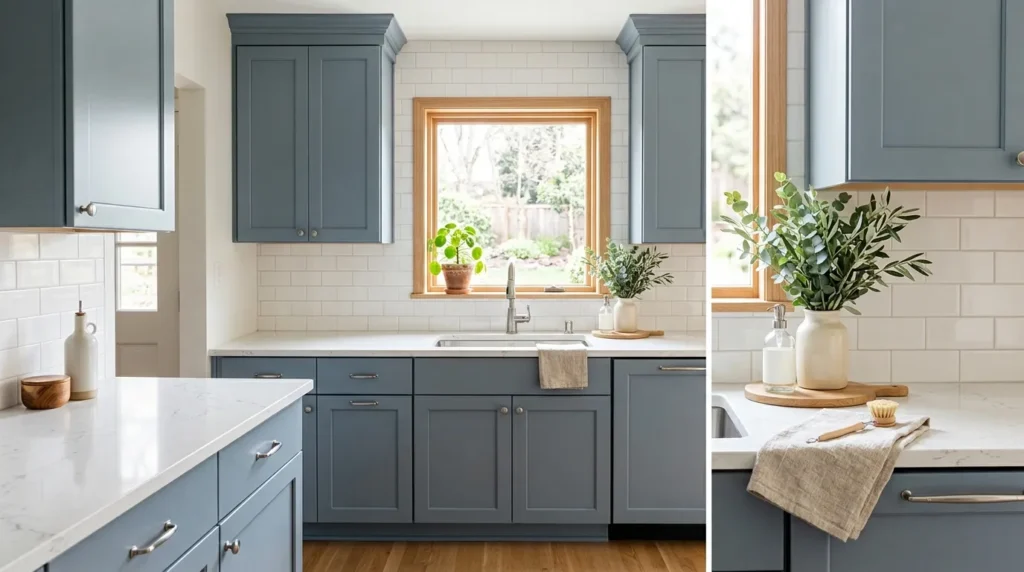
A white backsplash provides a strong visual contrast against blue gray cabinets.
Classic subway tile is especially effective because its simple rectangular shape doesn’t compete with the cabinet color.
The white surface also helps reflect light around the kitchen.
For small kitchens, using the backsplash material consistently across the main work area can create a cleaner visual field.
How To Style It
Choose warm white subway tile if your blue gray has warm undertones.
Use cooler white if the cabinets lean strongly blue.
Pay attention to grout.
A soft gray grout creates subtle definition, while white grout produces a more seamless appearance.
Pair the backsplash with light countertops.
Keep decorative items on the counter to a minimum.
The more continuous the light surfaces appear, the less visually crowded the kitchen can feel.
7. Brass Hardware
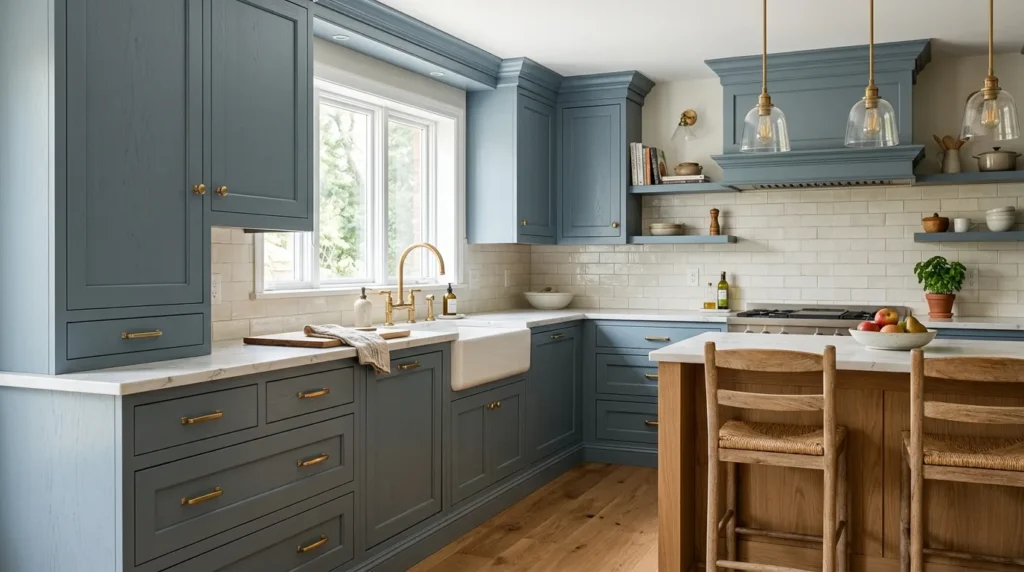
Quick Benefits
- Adds warmth
- Creates contrast
- Makes cabinetry feel more polished
- Complements blue gray beautifully
- Works with traditional and transitional designs
Why It Works
Blue gray is naturally cool.
Warm brass introduces a contrasting temperature that can make the overall kitchen feel more balanced.
Hardware is also a relatively small detail, which means you can introduce warmth without changing the entire color scheme.
Brass works particularly well with soft blue gray because the combination feels sophisticated without being overly formal.
How To Style It
Choose one dominant metal finish.
Use brass on cabinet pulls, knobs, faucets, or lighting where appropriate.
You don’t necessarily need every metal element to match perfectly, but too many unrelated finishes can create visual noise.
For a traditional kitchen, try aged or antique brass.
For a cleaner contemporary look, consider a softer brushed brass.
Pair the hardware with white counters and warm wood accents to create a cohesive palette.
8. Open Shelving
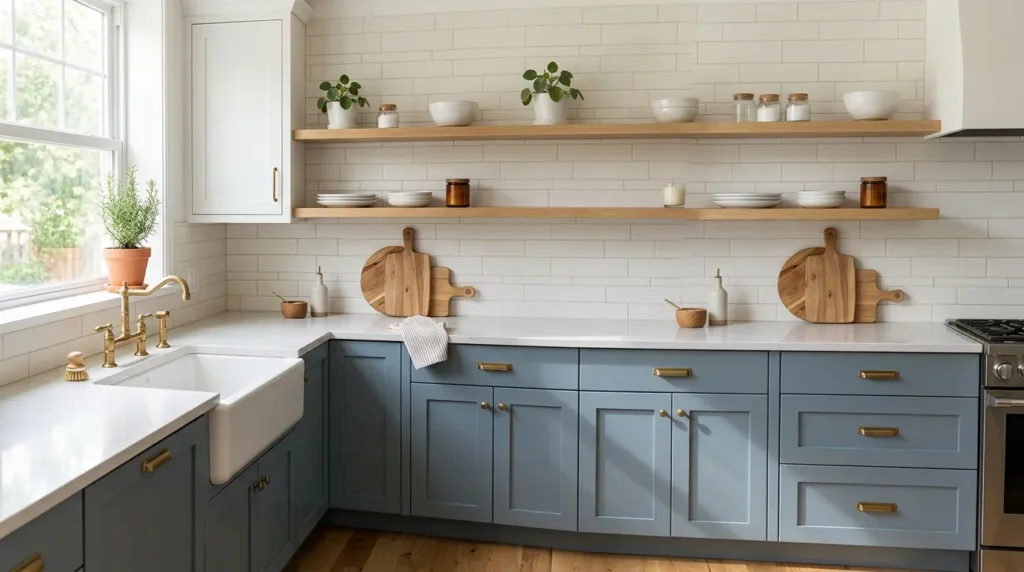
Quick Benefits
- Breaks up upper cabinets
- Creates visual breathing room
- Makes everyday items accessible
- Adds warmth
- Works well in smaller kitchens
Why It Works
Open shelving can make a kitchen feel less enclosed by replacing some visually heavy upper cabinetry with open space.
You don’t need to remove every upper cabinet.
One section of shelving can be enough.
The shelves create a horizontal visual line and provide an opportunity to introduce wood, ceramics, glass, and greenery.
The key is restraint.
Open shelves only look spacious when they aren’t overloaded.
How To Style It
Use two or three shelves rather than covering an entire wall.
Choose natural wood for warmth or painted shelves for a more seamless look.
Display only frequently used or visually pleasing pieces.
Try:
- White dishes
- Wooden cutting boards
- Ceramic bowls
- Glass jars
- Small plants
Leave some empty space between objects.
That negative space helps the kitchen feel lighter.
9. Two-Tone Cabinetry
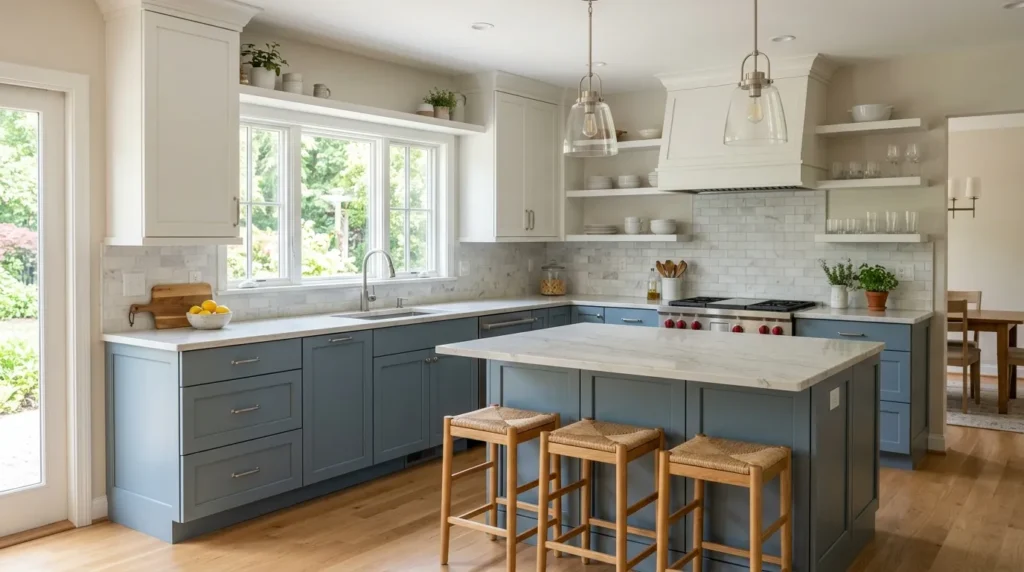
Quick Benefits
- Creates visual hierarchy
- Keeps upper cabinets light
- Adds personality
- Works in small kitchens
- Makes blue gray feel less dominant
Why It Works
Two-tone cabinetry can be one of the most effective ways to use a stronger cabinet color without making a kitchen feel enclosed.
Blue gray lower cabinets paired with white or cream uppers create a visual transition.
The lighter upper cabinets blend into a similarly colored wall, which can make the ceiling and upper portion of the kitchen feel more open.
The blue gray provides grounding below.
How To Style It
Use blue gray on lower cabinets and a soft white on upper cabinets.
Keep the countertop relatively light.
Choose a backsplash that connects the two cabinet colors.
For example, white tile with subtle gray veining can bridge the palette.
Add warm wood accents if the space feels too cool.
Avoid introducing another major cabinet color.
Two primary cabinet finishes are generally enough.
10. Soft Blue Gray
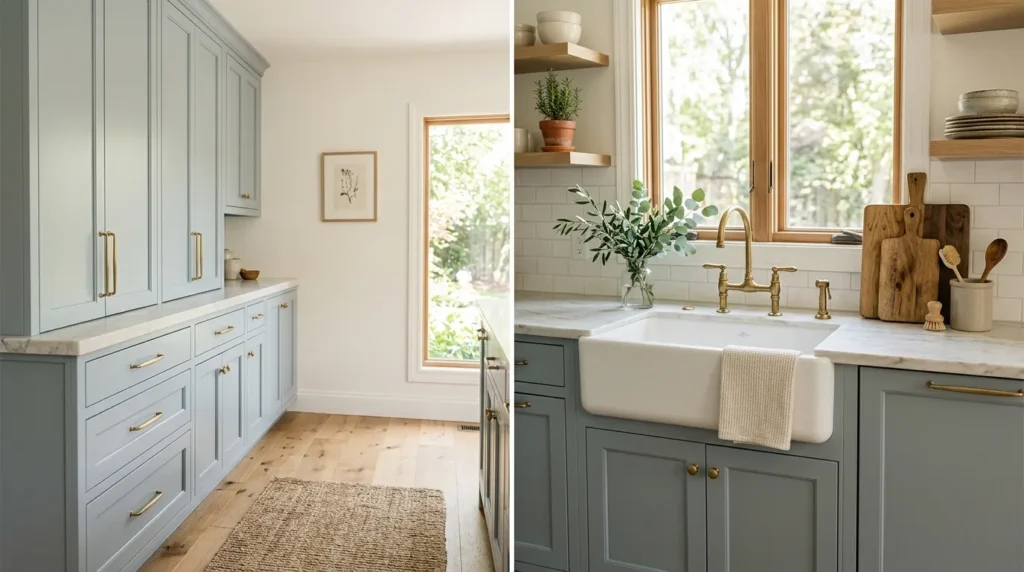
Quick Benefits
- Creates a calm atmosphere
- Adds color without overpowering
- Works with neutral materials
- Adapts to different lighting
- Looks sophisticated over time
Why It Works
A soft blue gray sits comfortably between color and neutral.
That makes it easier to decorate around than a highly saturated blue.
It can create a subtle coastal feeling with white and natural wood, a classic appearance with marble and brass, or a modern look with black hardware and simple surfaces.
The shade also changes with lighting.
In bright daylight, it may appear more blue.
Under warm evening lighting, its gray or green undertones may become more noticeable.
How To Style It
Test paint samples or cabinet swatches in your actual kitchen.
Observe them in morning, afternoon, and evening light.
Pair soft blue gray with warm white rather than automatically choosing a stark white.
Add natural wood and simple textiles for warmth.
Use light countertops and backsplash materials if your primary goal is visual openness.
Keep the rest of the palette calm so the cabinetry remains the feature.
How Blue Gray Cabinets Can Make a Kitchen Feel Bigger
Cabinet color alone doesn’t physically increase kitchen size.
Instead, the right combination of color, light, materials, and layout can create the perception of more space.
For a smaller kitchen, consider these strategies:
Use lighter blue gray: Pale shades generally have less visual weight.
Keep counters bright: White or light neutral surfaces can reflect more available light.
Reduce visual clutter: Clear countertops make the room feel more open.
Use consistent backsplash materials: A continuous surface can create visual flow.
Add reflective finishes: Glass, polished stone, and carefully selected metal accents can help distribute light.
Open up some upper storage: A small section of open shelving can break up a solid wall of cabinets.
Use under-cabinet lighting: Illuminating the countertop helps eliminate dark work areas.
Keep hardware simple: Small, consistent details reduce visual noise.
Best Countertops for Blue Gray Cabinets
The countertop can dramatically change how blue gray cabinetry looks.
White Marble
Creates a classic, sophisticated contrast.
White Quartz
Offers a clean appearance with practical everyday usability.
Warm White Quartz
Softens cooler cabinet colors and works beautifully with natural wood.
Light Gray Stone
Creates a monochromatic palette while maintaining contrast.
Butcher Block
Introduces warmth and texture, particularly in farmhouse or transitional kitchens.
Dark Countertops
Can create dramatic contrast, but they may make a smaller kitchen feel heavier if there isn’t enough natural or artificial light.
Best Hardware for Blue Gray Cabinets
The right hardware depends on the overall style.
Brushed Brass: Warm and sophisticated.
Aged Brass: Traditional and character-rich.
Matte Black: Modern and high contrast.
Brushed Nickel: Soft, versatile, and understated.
Chrome: Crisp and reflective.
For a kitchen intended to feel bright and spacious, avoid choosing hardware solely because it is trendy.
Instead, look at the faucet, appliances, lighting, and other metal finishes already present.
Common Blue Gray Kitchen Mistakes
Choosing color from a screen: Blue gray can look dramatically different depending on lighting.
Ignoring undertones: Some shades lean blue, green, or violet.
Using too many cool finishes: Blue gray, cool white, gray stone, and silver metal can make a kitchen feel cold.
Overloading open shelves: Display storage needs editing.
Choosing a dark countertop automatically: High contrast can make small kitchens feel heavier.
Forgetting lighting: Cabinet colors look different under daylight and artificial lighting.
Mixing too many wood tones: Warm wood should complement rather than compete with the cabinets.
Painting without testing: Always test a cabinet color in the actual kitchen before committing to a large project.
FAQ
Are blue gray cabinets good for small kitchens?
Yes. Lighter blue gray shades can work particularly well in smaller kitchens when paired with bright countertops, light backsplashes, and adequate lighting. The color provides personality without the visual weight of very dark cabinetry. The overall combination matters more than the cabinet color alone.
What color countertops go with blue gray cabinets?
White, warm white, light gray, and marble-look countertops are particularly versatile choices. White surfaces can create strong contrast and help maintain a bright appearance. Natural wood countertops can also work well when you want to introduce warmth and a more casual feel.
What backsplash looks best with blue gray cabinets?
White subway tile, warm white tile, marble-look slabs, and light neutral backsplashes all complement blue gray cabinetry. Choose the undertone carefully. A warm blue gray usually works better with warm white, while a cooler blue gray can pair nicely with crisp white or light gray.
What hardware color looks best with blue gray cabinets?
Brass, brushed nickel, matte black, and chrome can all work. Brass adds warmth, black creates stronger contrast, and brushed nickel offers a softer appearance. Consider the existing finishes in your kitchen so the hardware feels connected to the faucet, appliances, lighting, and other details.
Do blue gray cabinets make a kitchen look smaller?
Dark or highly saturated blue gray can make a small kitchen feel heavier if it is combined with dark countertops, limited lighting, and many contrasting materials. Pale or medium blue gray paired with bright surfaces can have the opposite effect by adding color while maintaining a visually open appearance.
Are blue gray cabinets still stylish?
Blue gray is a versatile cabinet color because it functions partly as a neutral. It can work with traditional, coastal, transitional, farmhouse, and contemporary interiors. Rather than relying on a particular trend, choose a shade and surrounding materials that complement your home’s architecture and your long-term preferences.
What colors go well with blue gray kitchen cabinets?
Blue gray pairs naturally with white, cream, warm beige, light wood, soft green, brass, black, and several neutral stone finishes. Keeping the palette relatively controlled usually creates a more cohesive kitchen. Warm accents can be especially useful if the blue gray has strong cool undertones.
Conclusion
Blue gray kitchen cabinets offer a practical middle ground for homeowners who want more personality than white cabinets but don’t want the visual heaviness that can come with very dark colors.
The key is balance.
Pair pale or soft blue gray with bright countertops, thoughtful lighting, simple backsplashes, and carefully chosen accents. Use the color on an island if you want a smaller commitment, or combine blue gray lowers with white uppers for a two-tone design.
Natural wood can warm the palette. Glass doors can break up solid cabinetry. Open shelving can introduce breathing room. Brass hardware can add a subtle touch of warmth.
And if your kitchen is small, remember that cabinet color is only one part of the equation.
Clear countertops, sensible storage, good lighting, appropriate proportions, and a cohesive material palette all contribute to how spacious a kitchen feels.
Before committing to a cabinet color, test samples in your own space and watch how they change throughout the day.
With the right combination, blue gray cabinetry can give your kitchen a calm, polished look while helping the room feel brighter, lighter, and more thoughtfully designed.
Related Articles
- 10 French Style Kitchen Ideas with Open Shelves
- 10 Modern Kitchen Ideas with Warm Wood Accents
- 10 Small Kitchen Ideas That Make the Space Feel Bigger
- 10 White Kitchen Ideas with Natural Wood Accents
- 10 Kitchen Cabinet Color Ideas for a Timeless Home