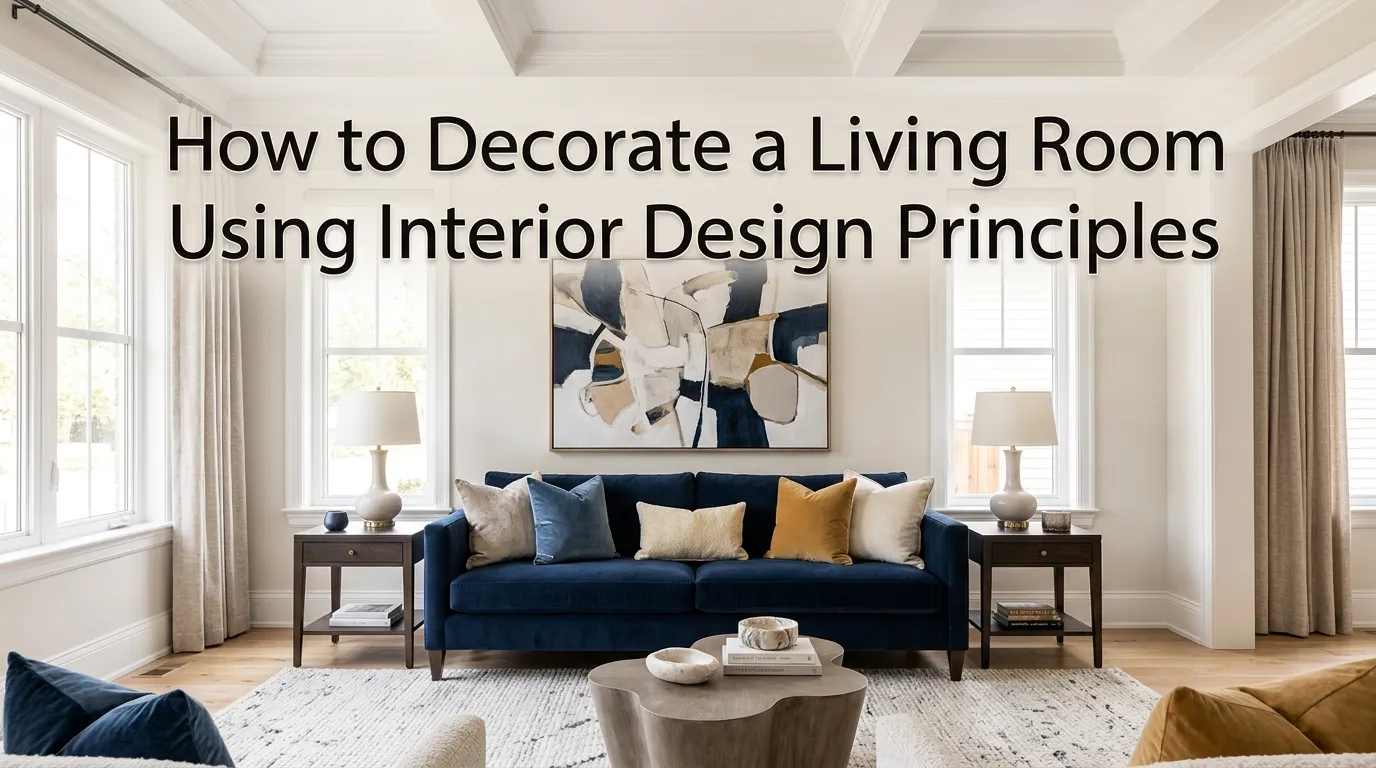
How to Decorate a Living Room Using Interior Design Principles
Decorating a living room can feel overwhelming when you’re surrounded by beautiful furniture, paint colors, rugs, lighting, and accessories that all look great individually. The real challenge is making everything work together.
That’s where interior design principles become useful.
You don’t need a professional design degree or an unlimited decorating budget to create a living room that feels balanced and intentional. Basic principles such as scale, proportion, balance, rhythm, contrast, color, texture, and focal points can help you make better decisions before you buy anything.
I’ve found that the biggest decorating improvements often come from changing the relationship between existing pieces rather than replacing everything. Moving a sofa away from the wall, choosing a correctly sized rug, repeating a color through the room, or adding another layer of lighting can completely change how the space feels.
The goal isn’t to make your living room look like a showroom. A successful room should still feel comfortable enough for everyday life.
If you’re decorating a new home, refreshing a tired space, or simply trying to understand why your living room doesn’t quite feel finished, these principles give you a practical framework.
You’ll learn how to arrange furniture, choose a cohesive color palette, create visual balance, layer lighting, mix textures, and add accessories without making the room feel cluttered.
Most importantly, you’ll have a system for making decorating decisions with more confidence.
Table of Contents
1. Establish A Focal Point
Create one strong visual anchor that naturally draws attention.
2. Balance Furniture
Distribute visual weight so the room feels stable and comfortable.
3. Get The Scale Right
Choose furniture and decor that fit the proportions of the room.
4. Build A Color Palette
Use a controlled color scheme to create visual cohesion.
5. Layer The Lighting
Combine multiple light sources for a comfortable atmosphere.
6. Add Texture
Mix materials and surfaces to give the room depth.
7. Create Visual Rhythm
Repeat colors, shapes, and materials throughout the space.
8. Define Conversation Areas
Arrange seating around how people actually use the room.
9. Use Negative Space
Leave intentional breathing room between furniture and decor.
10. Finish With Accessories
Use carefully selected objects to add personality and polish.
1. Establish A Focal Point
Quick Benefits
- Gives the room a clear visual anchor
- Makes furniture placement easier
- Creates a stronger first impression
- Prevents competing visual distractions
- Helps accessories feel intentional
Why It Works
Every living room benefits from a visual destination.
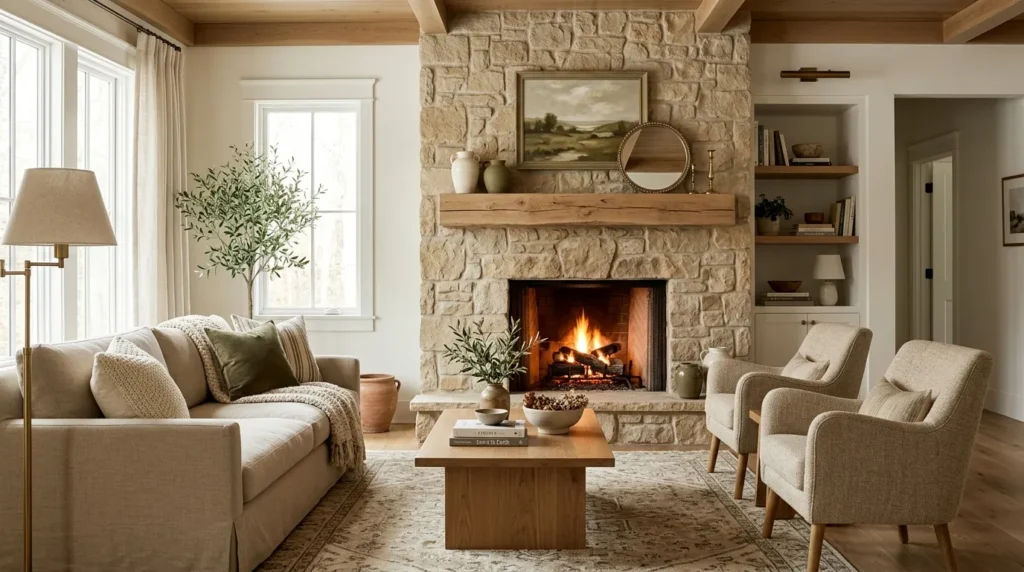
A focal point is the element your eye notices first or naturally returns to. It might be a fireplace, large window, architectural feature, artwork, media console, or beautifully styled wall.
Without a focal point, furniture and accessories can compete for attention, making the room feel scattered.
Interior designers often use focal points to establish hierarchy. Not everything in a room needs to demand attention at the same level.
A strong focal point also helps determine furniture orientation.
If you have a fireplace, for example, seating can be arranged toward it. If the main feature is a large window with a beautiful view, you may want to orient furniture so the view remains visible rather than blocking it.
How To Style It
Start by identifying the strongest existing feature in your room.
If there isn’t one, create one.
A large piece of artwork above a sofa can work beautifully. A substantial mirror can reflect light and create visual interest. A built-in fireplace can become the architectural center.
Avoid putting multiple oversized decorative pieces directly opposite one another.
Instead, allow one feature to lead while the others support it.
Use lighting to emphasize the focal point after dark.
For artwork, make sure its size relates to the furniture beneath it. A tiny frame above a large sofa can feel disconnected.
2. Balance Furniture
Quick Benefits
- Makes the room feel stable
- Improves furniture placement
- Prevents one side from feeling heavy
- Creates a more comfortable layout
- Helps open-plan spaces feel organized
Why It Works
Balance doesn’t mean everything has to match.
Instead, it means visual weight is distributed throughout the room.
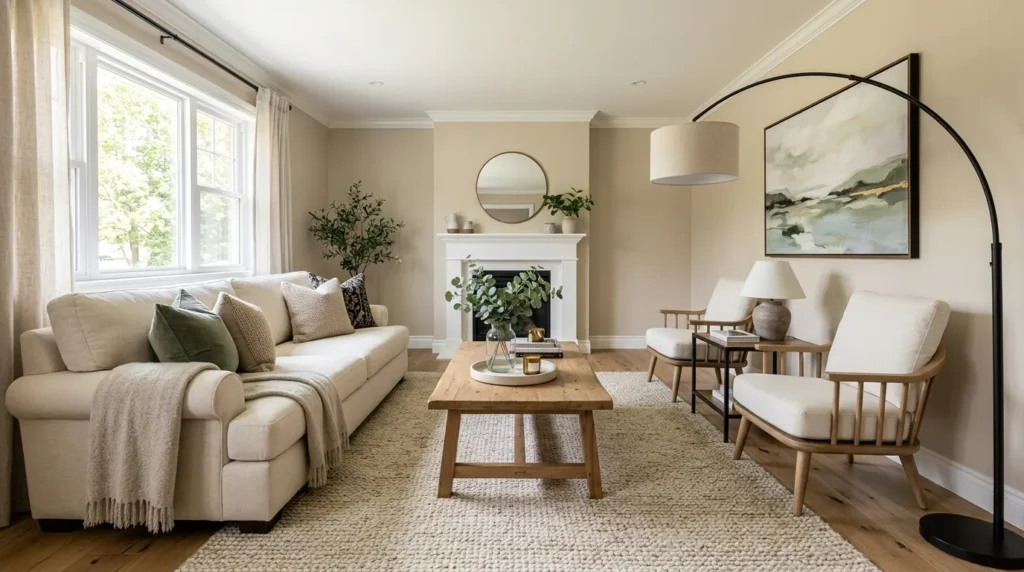
A large sectional on one side may need a substantial chair, floor lamp, console, or artwork on the opposite side to prevent the arrangement from feeling visually lopsided.
There are several ways to create balance.
Symmetrical arrangements use matching or similar objects on opposite sides.
Asymmetrical balance uses different objects with comparable visual weight.
For example, one large armchair and floor lamp might balance a smaller chair paired with a substantial side table.
The goal is to make the room feel grounded without making it predictable.
How To Style It
Begin with the largest furniture pieces.
Place the sofa first, then consider chairs, coffee tables, consoles, and storage pieces.
Step back and look at the room as a whole.
If one corner feels significantly heavier, add visual weight to the opposite area rather than automatically adding another large piece of furniture.
You can use:
- Tall plants
- Floor lamps
- Large artwork
- Curtains
- Accent chairs
- Console tables
- Bookcases
Balance can also be created through color.
A dark chair on one side might be visually repeated through a dark lamp base or artwork frame elsewhere.
3. Get The Scale Right
Quick Benefits
- Makes furniture feel intentional
- Improves comfort
- Prevents rooms from feeling crowded
- Creates better visual proportions
- Helps large and small pieces coexist
Why It Works
Scale is one of the easiest principles to overlook.
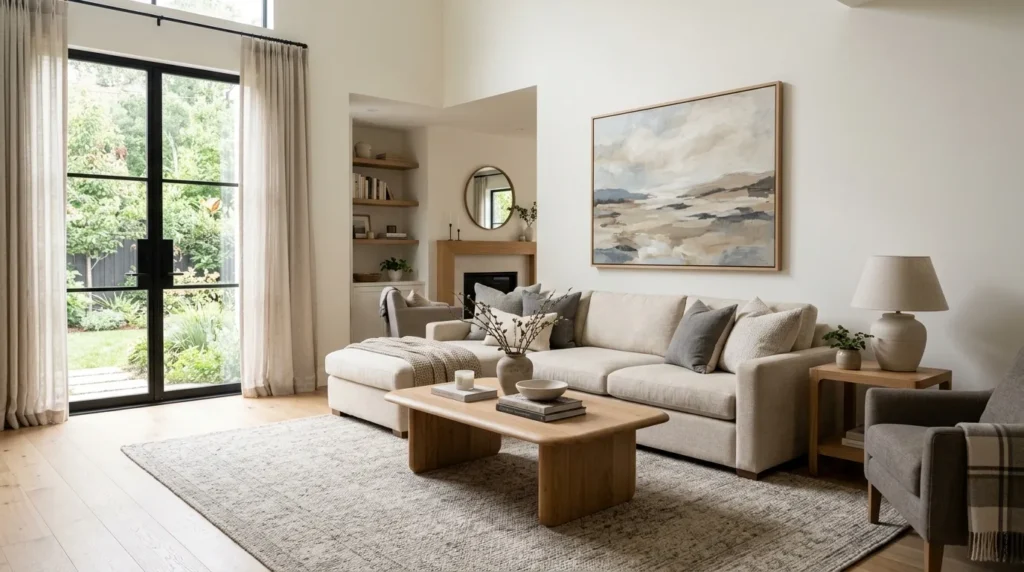
A small coffee table in front of a large sectional can look lost. An oversized sectional in a compact room can overwhelm everything around it.
Good decorating isn’t simply about finding beautiful furniture.
It’s about finding pieces that relate appropriately to one another and to the room itself.
Proportion refers to the relationship between individual elements.
Scale considers how those elements relate to the overall space.
Both matter.
How To Style It
Measure your room before shopping.
Measure the sofa, coffee table, doorways, and walking areas.
Think about how much visual space each item occupies.
A large room may comfortably handle:
- A substantial sectional
- Oversized artwork
- Large area rug
- Multiple accent chairs
- Larger lighting
A smaller living room may benefit from:
- Slim-profile seating
- Furniture with visible legs
- Smaller accent tables
- Appropriately sized artwork
- A lighter visual silhouette
Don’t assume that small rooms require tiny furniture.
Sometimes one appropriately scaled sofa looks better than several small pieces that create visual clutter.
4. Build A Color Palette
Quick Benefits
- Creates cohesion
- Makes decorating decisions easier
- Helps furniture coordinate
- Adds visual rhythm
- Creates a more finished appearance
Why It Works
A cohesive color palette doesn’t mean using only three colors throughout the room.
Instead, it means creating relationships between the colors.
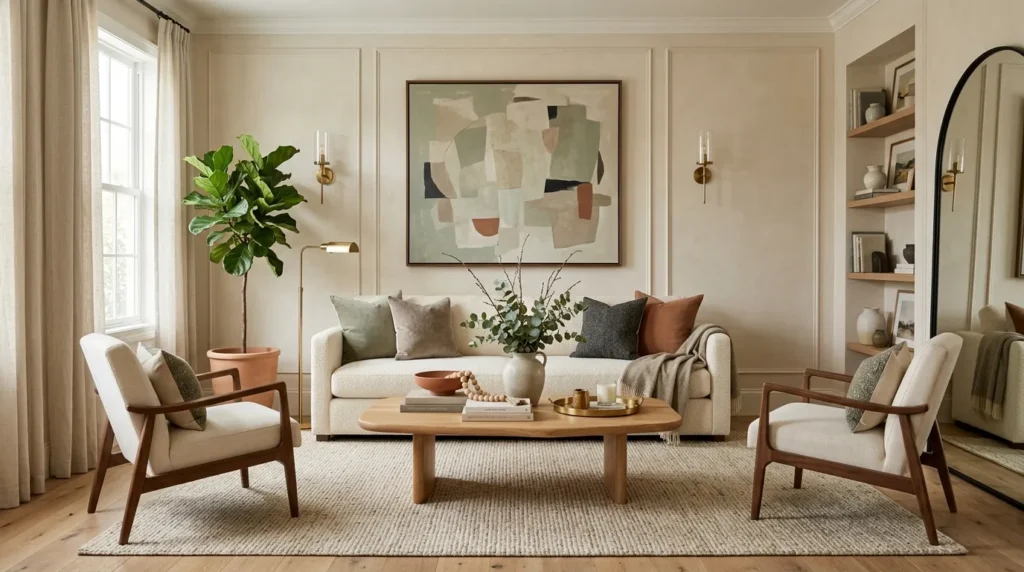
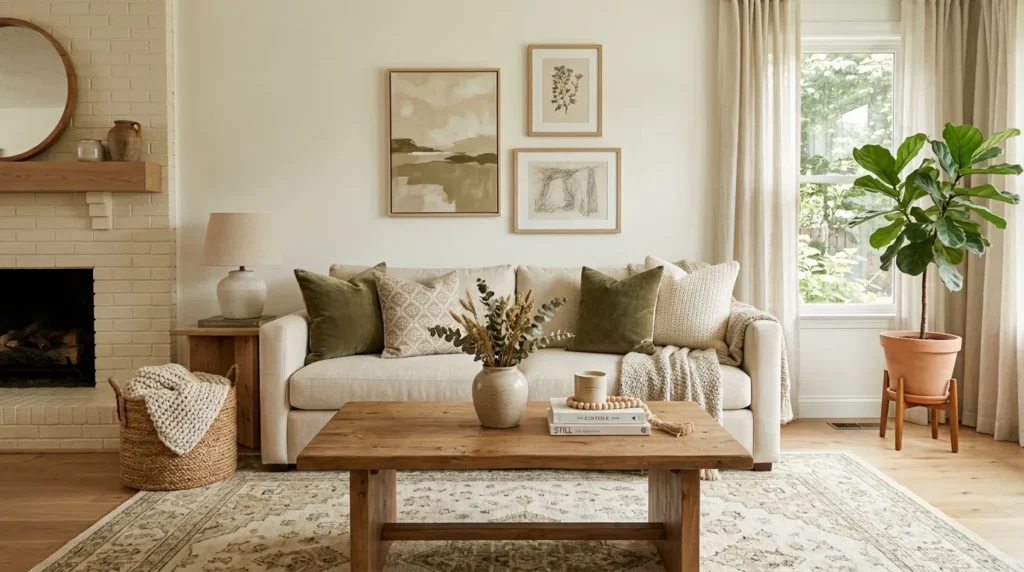
A useful starting point is to choose a dominant color, a secondary color, and a smaller accent color.
For example:
Dominant: Warm white
Secondary: Natural beige and wood
Accent: Muted olive green
The colors can appear in different materials and proportions.
This repetition helps the room feel connected.
Color also affects perceived atmosphere.
Light neutrals can make a room feel brighter, while deeper colors create visual weight and intimacy.
How To Style It
Start with something you already love.
It could be:
- A rug
- Artwork
- Sofa
- Curtains
- Favorite chair
- Decorative object
Pull two or three colors from that item.
Repeat them throughout the room rather than introducing unrelated colors.
If your sofa is neutral, use pillows, artwork, throws, and accessories to introduce the accent palette.
Don’t feel obligated to match everything exactly.
Slight variations usually make a room feel more natural.
5. Layer The Lighting
Quick Benefits
- Makes the room more comfortable
- Adds depth
- Highlights architectural features
- Improves evening ambiance
- Prevents harsh illumination
Why It Works
One ceiling light rarely creates the most comfortable living room.
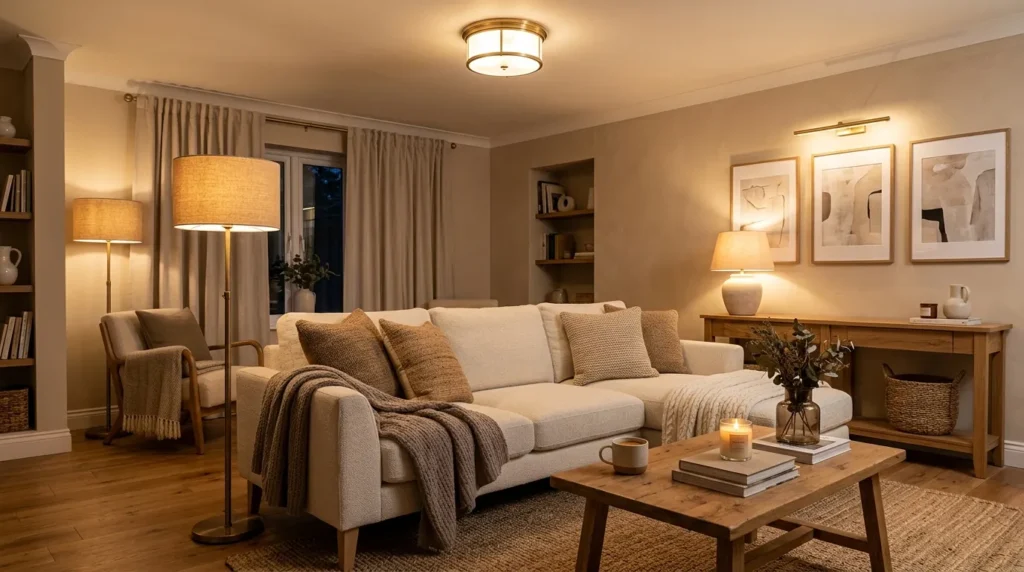
Layered lighting uses several sources at different heights.
This might include overhead lighting, floor lamps, table lamps, wall sconces, picture lights, and natural daylight.
Different lighting sources create pools of illumination rather than flooding the entire room with one intense light.
This gives you more control over the atmosphere.
A living room should support several activities, from reading and watching television to talking with guests and relaxing at night.
How To Style It
Think in three general layers:
Ambient lighting: Provides overall illumination.
Task lighting: Supports activities such as reading.
Accent lighting: Highlights artwork, shelves, plants, or architectural features.
Place lamps around the room rather than concentrating them in one area.
Use dimmers where practical.
Choose bulbs with a comfortable color temperature appropriate for your home’s evening environment.
And don’t underestimate natural light.
Keep windows relatively unobstructed if daylight is one of your room’s strongest features.
6. Add Texture
Quick Benefits
- Makes neutral rooms more interesting
- Adds visual depth
- Creates a comfortable atmosphere
- Prevents flat-looking decor
- Helps materials work together
Why It Works
A room can have a beautiful color palette and still feel unfinished if every surface has the same visual quality.
Texture solves that problem.
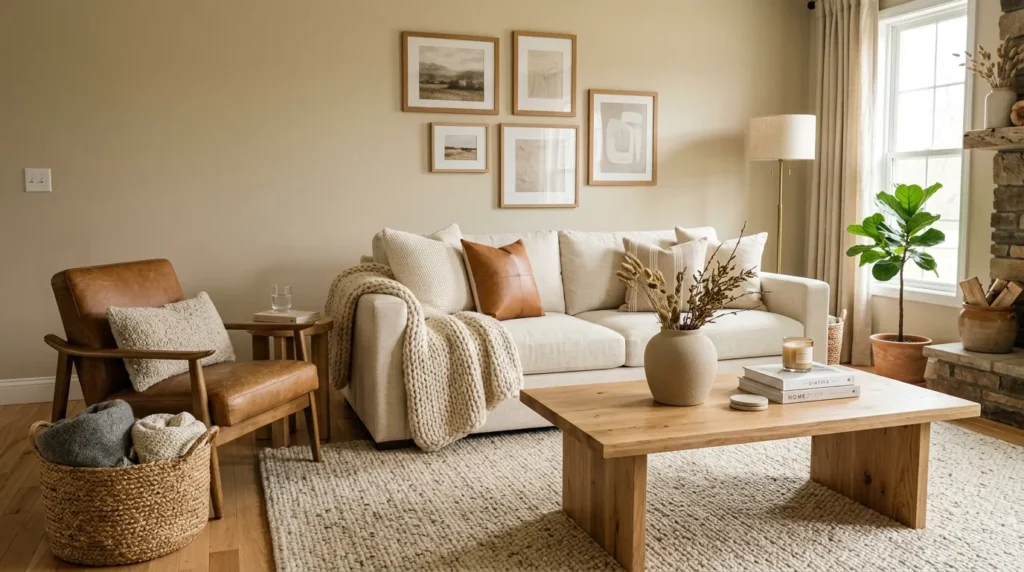
Think about the difference between smooth leather, woven linen, chunky wool, natural wood, ceramic, glass, and metal.
Even when these materials share similar colors, they reflect and absorb light differently.
That variation gives the room depth.
Texture is especially useful in neutral living rooms.
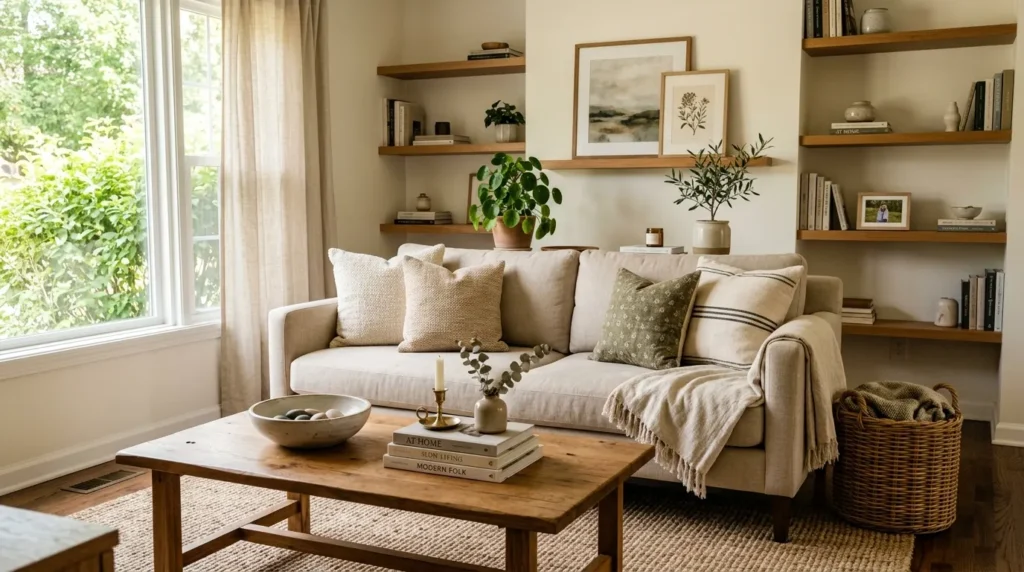
A beige sofa doesn’t have to look boring when it’s surrounded by woven baskets, linen curtains, textured pillows, wood furniture, a wool rug, and ceramic accessories.
How To Style It
Aim for a mixture of materials.
Try combining:
- Linen
- Wool
- Wood
- Ceramic
- Glass
- Metal
- Bouclé
- Woven fibers
- Leather
Don’t add texture randomly.
Repeat a few materials throughout the room so the result feels coordinated.
For example, natural wood can appear in the coffee table, picture frames, and side tables.
A woven texture can appear in the rug and basket.
7. Create Visual Rhythm
Quick Benefits
- Connects different parts of the room
- Makes decorating feel cohesive
- Creates movement for the eye
- Prevents isolated-looking pieces
- Strengthens the color palette
Why It Works
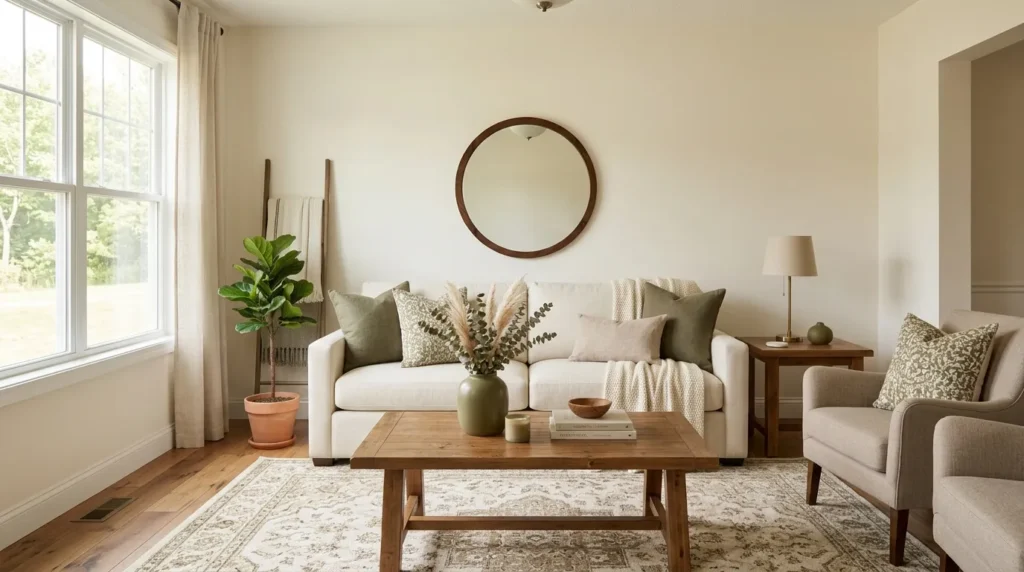
Rhythm is created when elements repeat or progress throughout a room.
The repetition might involve color, shape, pattern, material, or architectural detail.
For example, a muted blue accent could appear in a pillow, artwork, vase, and rug pattern.
Your eye recognizes the repetition and begins to connect those elements.
Rhythm doesn’t require identical objects.
In fact, exact repetition can make a room feel overly staged.
The goal is subtle consistency.
How To Style It
Choose two or three elements to repeat.
You might repeat:
- Rounded shapes
- Black metal
- Warm wood
- Olive green
- Brass
- Stripes
- Natural fibers
Use them at different points around the room.
A round coffee table could be echoed by a round mirror and rounded ceramic vase.
A brass floor lamp could connect with brass picture frames.
These small relationships can make a room feel much more intentionally designed.
8. Define Conversation Areas
Quick Benefits
- Improves functionality
- Encourages comfortable interaction
- Makes large rooms feel organized
- Helps open-plan spaces
- Creates clearer furniture placement
Why It Works
A living room should work for people, not just photographs.
Furniture placement needs to support the way you actually use the space.
If you frequently entertain, seating should allow people to face one another comfortably.
If the room is primarily used for watching television, the screen needs to be visible without forcing everyone into awkward positions.
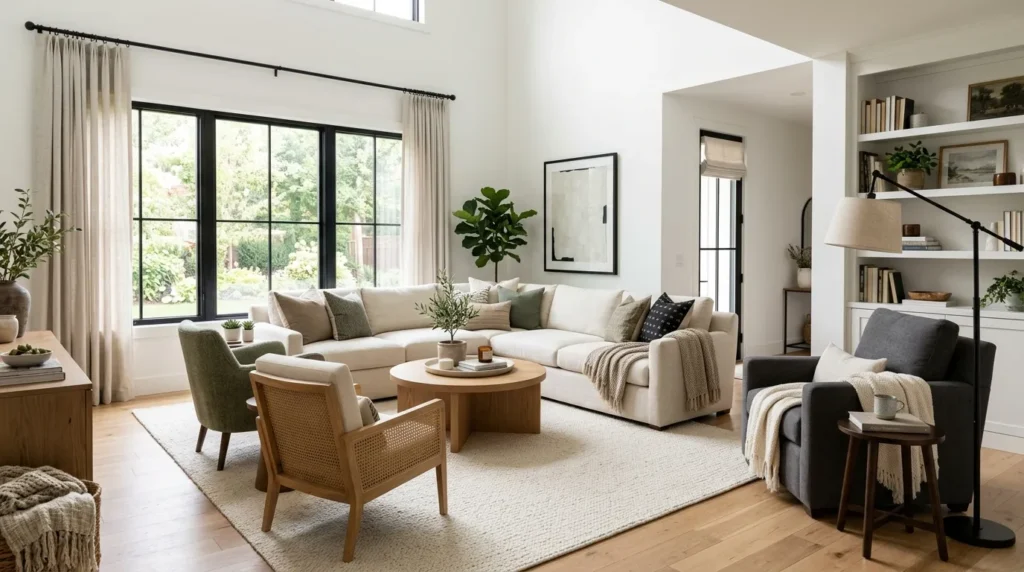
Large open rooms can benefit from multiple zones.
Instead of pushing all furniture against the walls, create smaller functional areas within the larger space.
How To Style It
Start with the main seating arrangement.
Position the sofa and chairs so people can communicate comfortably.
Use a coffee table to anchor the center.
An area rug can visually define the seating zone.
In a large room, consider adding a reading corner with an accent chair and floor lamp.
For an open-concept home, a console table behind a sofa can subtly separate the living room from the dining or kitchen area.
Keep walking paths clear.
Good circulation is an important part of good design.
9. Use Negative Space
Quick Benefits
- Makes rooms feel less cluttered
- Highlights important furniture
- Improves circulation
- Creates visual calm
- Gives accessories more impact
Why It Works
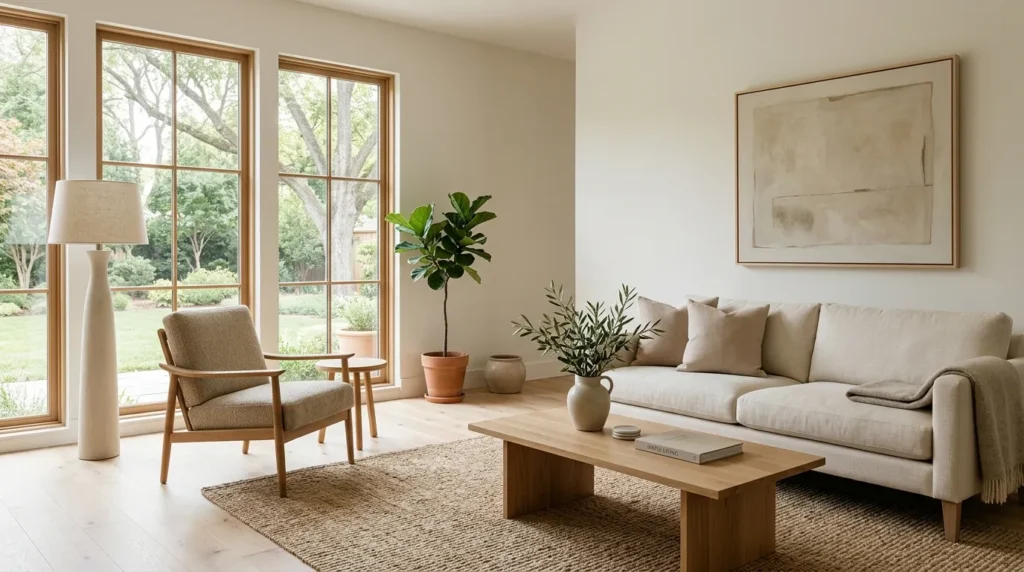
Empty space is part of the design.
Many homeowners assume that a room feels unfinished if every surface isn’t decorated.
In reality, intentional negative space can make a room look more sophisticated.
It allows important pieces to breathe.
Negative space can exist between furniture, around artwork, on shelves, and across countertops or tabletops.
It also affects movement.
A beautiful room that is difficult to walk through doesn’t function well.
How To Style It
Resist the temptation to fill every empty corner.
Leave some space around:
- Coffee tables
- Accent chairs
- Artwork
- Shelving
- Side tables
- Windows
Edit accessories regularly.
If a shelf feels crowded, remove a few objects rather than automatically rearranging everything.
Give larger decorative pieces enough room to be appreciated.
In smaller living rooms, this principle becomes particularly important.
10. Finish With Accessories
Quick Benefits
- Adds personality
- Makes the room feel lived-in
- Reinforces the color palette
- Introduces texture
- Creates a finished appearance
Why It Works
Accessories are the final layer of a living room.
They can include artwork, pillows, throws, books, plants, vases, baskets, candles, sculptures, and collected objects.
The best accessories aren’t simply decorative.
They tell something about the people who live there.
A room can have perfect furniture placement and still feel impersonal without meaningful details.
At the same time, too many accessories can undermine everything you’ve accomplished with scale, balance, and negative space.
How To Style It
Decorate in layers.
Start with larger pieces.
Then add medium-size objects.
Finish with smaller details.
Try grouping objects in odd-numbered arrangements when it feels natural.
Mix heights rather than lining everything up at the same level.
Use trays to organize smaller objects on coffee tables.
Add greenery for organic texture.
And don’t be afraid to leave parts of the room undecorated.
A few meaningful pieces generally have more impact than a collection of unrelated objects.
How to Arrange a Living Room Step by Step
If you’re starting from an empty room, don’t buy accessories first.
Work from the largest elements down.
Step 1: Measure the Room
Record wall lengths, ceiling height, windows, doors, outlets, and architectural features.
Step 2: Identify the Focal Point
Decide whether the fireplace, window, artwork, television, or another feature should lead the room.
Step 3: Place the Sofa
The sofa is usually the largest piece, so use it as the starting point.
Step 4: Add Additional Seating
Place chairs or loveseats to support conversation and balance.
Step 5: Add the Rug
Use the rug to visually connect the main seating pieces.
Step 6: Position the Coffee Table
Leave comfortable clearance between seating and the table.
Step 7: Add Side Tables
Place useful surfaces where people can comfortably reach them.
Step 8: Layer Lighting
Add floor, table, wall, and accent lighting as needed.
Step 9: Add Window Treatments
Hang curtains thoughtfully to enhance the windows and ceiling height.
Step 10: Decorate Last
Add artwork, pillows, throws, plants, books, and accessories after the furniture arrangement works.
Common Living Room Decorating Mistakes
Pushing Everything Against the Walls
This can create an awkward empty center.
Furniture sometimes looks better when it floats within the room.
Choosing a Tiny Rug
A small rug can make an otherwise spacious seating arrangement feel disconnected.
Choose a size that relates to the major furniture pieces.
Using Only One Light Source
A single ceiling fixture often creates flat or harsh lighting.
Layer different light sources.
Matching Everything Too Closely
A room filled with identical finishes can feel like a furniture showroom.
Mix related materials and shapes.
Ignoring Scale
Beautiful furniture can still look wrong when its proportions don’t suit the room.
Overdecorating Shelves
Objects need breathing room.
Forgetting Function
A living room should be comfortable for everyday activities, not simply attractive in photographs.
FAQ
What are the main principles of interior design for a living room?
Important principles include balance, proportion, scale, rhythm, harmony, contrast, emphasis, and functionality. You don’t need to apply every principle equally. Start with furniture scale, balance, focal points, and function, then use color, texture, rhythm, and accessories to refine the room.
How do I make my living room look professionally designed?
Start with a well-planned furniture layout and correctly sized rug. Then establish a cohesive color palette, layer lighting, mix textures, and repeat a few materials or colors throughout the room. Professional-looking spaces usually feel coordinated without making every item identical.
Should living room furniture face the TV or each other?
It depends on how you use the room. If watching television is the main activity, seating needs a comfortable view of the screen. If conversation and entertaining are more important, arrange seating so people can comfortably face one another. In larger rooms, you can often balance both purposes.
How many colors should a living room have?
There isn’t a strict limit, but a controlled palette often feels more cohesive. Choose a dominant color, one or two supporting colors, and a few small accents. Variations in tone and texture can add interest without introducing many unrelated colors.
How do I make a small living room look bigger?
Use appropriately scaled furniture, avoid unnecessary clutter, maintain clear walking paths, and choose a rug large enough to visually connect the seating. Light colors can help, but they aren’t mandatory. Mirrors, visible furniture legs, layered lighting, and intentional negative space can also contribute to an open feeling.
Should all living room furniture match?
No. A coordinated room generally looks more interesting when furniture is related rather than identical. You can mix different seating styles as long as they share some connection through color, scale, material, or overall design language.
Where should I start when decorating a living room?
Begin with the room itself. Identify its focal point, measure the available space, consider how the room will be used, and determine the largest furniture pieces you need. Once the layout works, build the color palette, lighting, textiles, artwork, and accessories around it.
Conclusion
Decorating a living room becomes much easier when you stop treating every decision as an isolated choice.
A sofa isn’t just a sofa. Its size affects the coffee table, rug, chairs, walking space, and visual balance around it.
A color isn’t just a color. It influences how artwork, textiles, flooring, lighting, and accessories relate to one another.
That’s the value of interior design principles.
Start with function and scale. Establish a focal point. Create balance. Build a restrained color palette. Layer lighting and texture. Repeat a few materials or colors to establish rhythm. Then use negative space to give the room room to breathe.
Finally, bring in personal accessories that make the space feel like yours.
You don’t have to redesign everything at once.
Move one piece of furniture. Replace an undersized rug. Add a floor lamp. Edit your shelves. Introduce a new texture. Sometimes a few thoughtful changes can reveal what your living room was missing all along.
The best living rooms aren’t necessarily the most expensive or trend-driven. They’re the ones where the furniture, colors, materials, lighting, and personal details work together naturally.
Related Articles
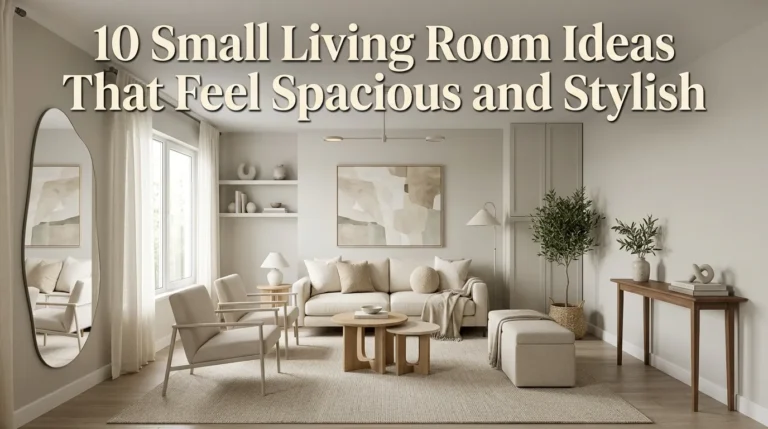
- 10 Small Living Room Ideas That Feel Spacious and Stylish
- How to Decorate a Living Room with Cozy Layered Decor
- 10 Modern Living Room Ideas with Luxury Style
- 10 DIY Wall Art Ideas for Living Room Walls
- 10 DIY Coffee Tables That Look Truly Custom Built